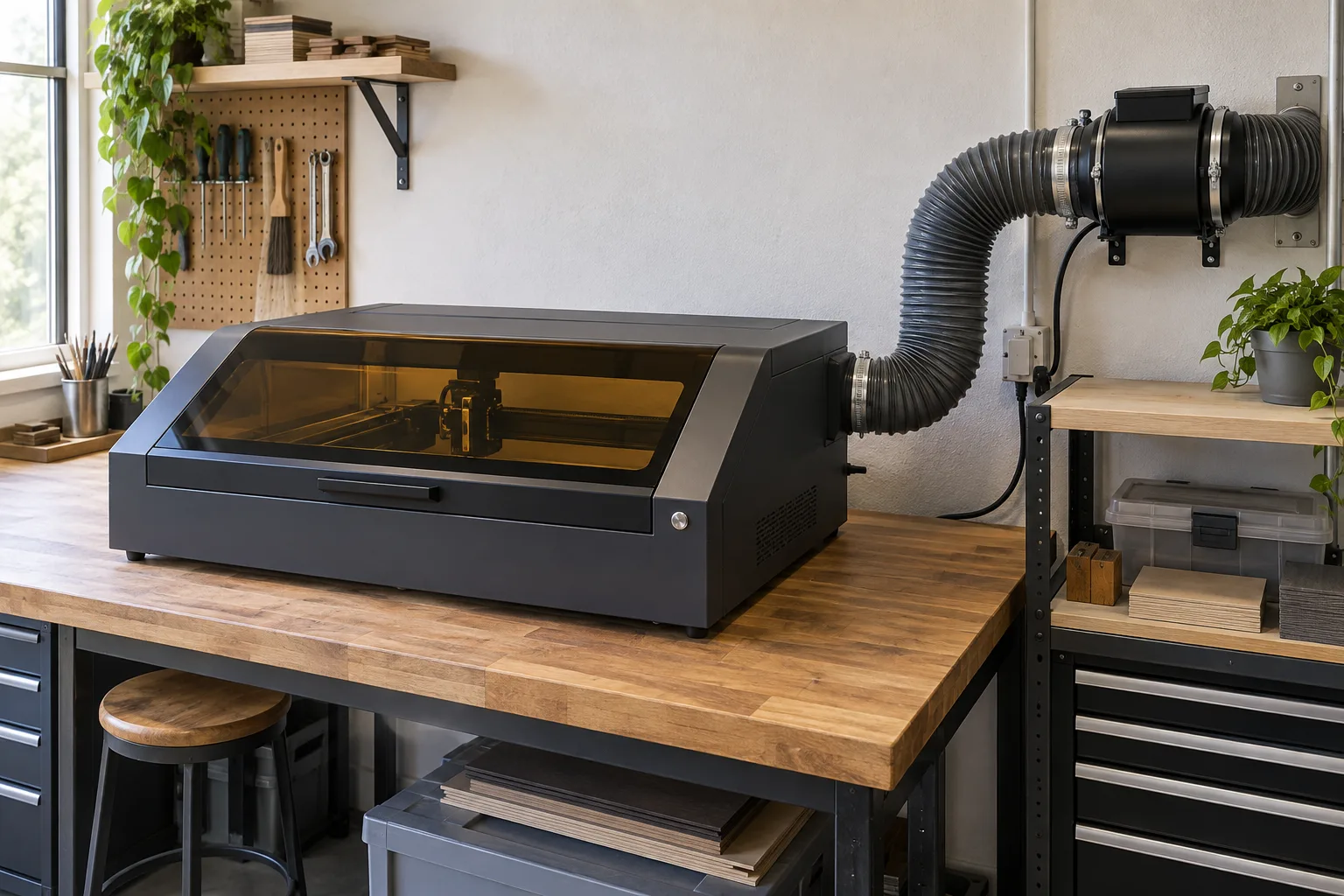
Capture at the source
The most useful exhaust setup captures fumes close to the engraving zone and keeps the enclosure under a controlled airflow. A loose hose near an open machine may move air, but it does not give you the same containment or repeatability as a properly connected enclosure.
Check the machine maker’s required connection, outlet size and operating guidance. Keep doors, panels and seals in the state intended for the process. If the enclosure is opened during a run, the designed airflow path may no longer be valid.
Do not shop by fan number alone
Real airflow depends on duct length, bends, filters, seals, backpressure and the shape of the capture path. A fan’s headline rating without the system resistance is not a reliable comparison. Ask for the operating condition and the complete equipment specification.
Also check sound, vibration, service access and where the fan sits. A system that is technically powerful but impossible to maintain may be bypassed in daily use. Keep the route as short and direct as the building allows, without creating unsafe discharge.
Plan discharge and replacement air
Exhaust has to go somewhere. Follow local building and fire requirements, the machine maker’s instructions and the material safety information for the process. Do not discharge into an occupied room, attic, wall cavity or another location where fumes can return.
When air leaves a room, replacement air must enter without blowing across the work zone or back into the operator’s breathing area. A sealed room can reduce capture performance; an uncontrolled draft can disturb the process. The right balance is part of the installation, not a last-minute window opening.
Know what filtration can and cannot do
Filters collect some particles and compounds, but no filter is universal and every filter has a service life. Confirm the filter type, replacement plan and approved materials with the equipment supplier. Do not treat a general room purifier as proof that a process is safe.
Record the material, run time, visible residue and filter change date. If odor, smoke or residue appears outside the expected path, stop and troubleshoot the capture system before continuing the job.
Exhaust system comparison
| System question | Why it matters | Evidence to request |
|---|---|---|
| Where is capture happening? | Source capture is more controlled than room dilution. | Machine connection and enclosure diagram. |
| What resistance is expected? | Ducts, bends and filters reduce delivered airflow. | Operating specification, not only free-air rating. |
| Where does air discharge? | The outlet must not return fumes to occupied space. | Installation and building guidance. |
| How is it maintained? | Blocked ducts and loaded filters change performance. | Inspection and replacement schedule. |
Before you compare machines
- Trace the full path from the engraving zone to approved discharge.
- Compare delivered airflow under system resistance, not only the fan label.
- Plan replacement air without a draft through the work area.
- Record material compatibility, filter life and maintenance access.
Questions worth answering first
Can I vent a laser engraver out a window?
Only if the complete installation is allowed by the machine guidance and local building, fire and housing requirements. The outlet must not send fumes toward people or back into the building.
Is an inline fan enough for a laser engraver?
A fan is only one part of the exhaust path. Capture, enclosure sealing, duct resistance, discharge and maintenance all determine whether the system performs as intended.
Does a carbon filter replace exhaust?
Not automatically. Filter media, material compatibility, loading and service life matter, and some processes should use a different capture or discharge method. Follow the equipment and material guidance.