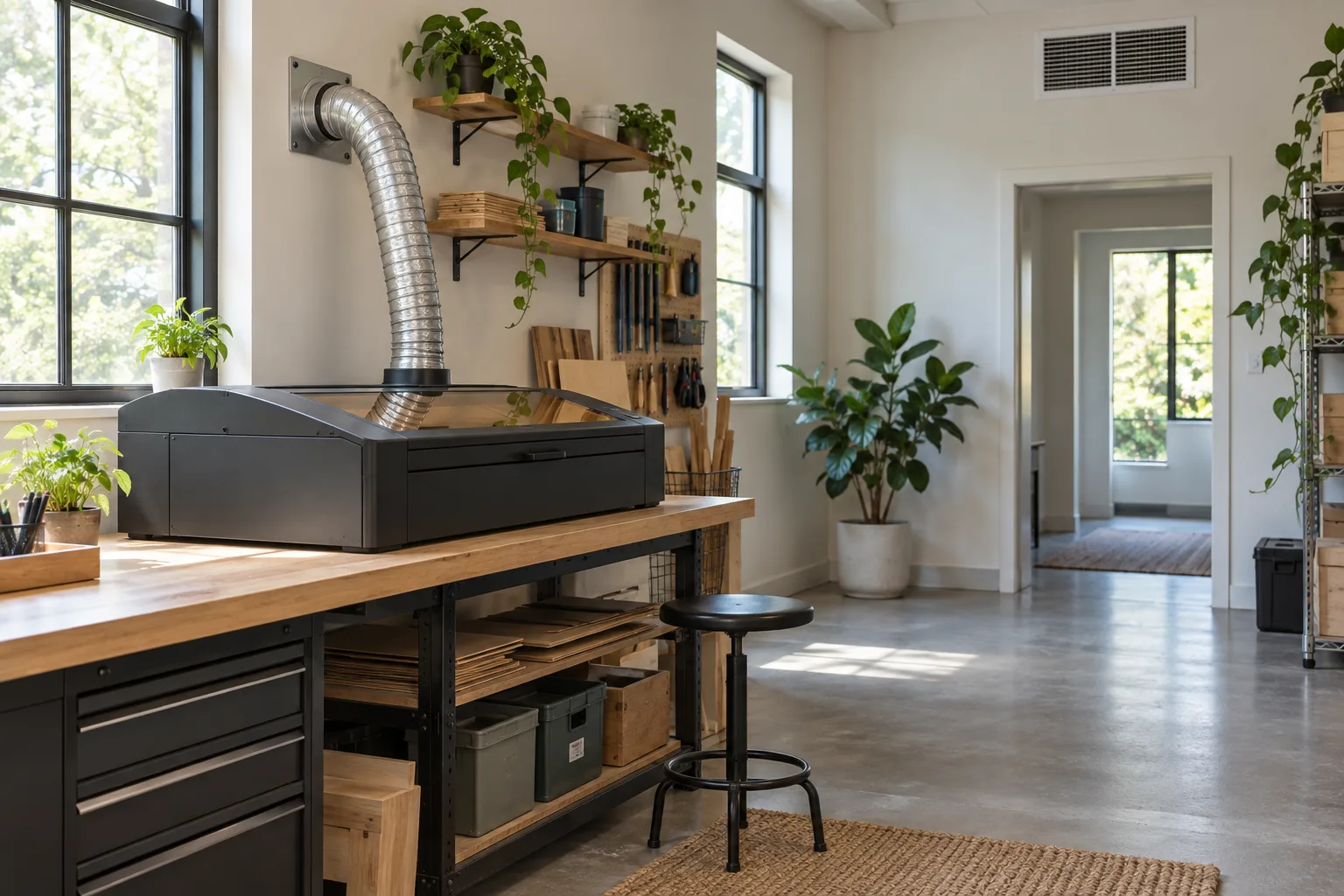
Exhaust and ventilation solve different problems
Local exhaust removes air from the enclosure or capture point. General ventilation manages the room’s overall air quality, heat and replacement air. A ceiling fan or open door may move room air, but it does not prove that fumes are captured where they are created.
Start with the machine’s required enclosure and exhaust setup. Then look at the room: where does replacement air enter, where does exhausted air leave, and can the flow move fumes toward another person or occupied area?
Avoid drafts across the work zone
Air movement can affect smoke capture, residue and sometimes the consistency of the mark. Do not place a supply vent so it blows across an open work area or directly at the enclosure opening. The goal is a controlled path, not maximum turbulence.
If a room becomes uncomfortable when the exhaust runs, solve the replacement-air problem deliberately. A cracked window in an unpredictable position can change the process every time the weather changes. Document the normal operating setup and keep doors, vents and fans in repeatable positions.
Filtration is not a universal safety stamp
Portable filtration can be part of a designed system, but its performance depends on the material, filter media, airflow, seals and maintenance. Odor reduction is not the same as removal of every hazardous component. Ask what the equipment is designed to capture and what it excludes.
Keep a service record and replace filters on the equipment maker’s schedule or sooner if the process changes. If the material changes, revisit the entire air plan instead of assuming the same filter remains suitable.
Make the room part of the setup checklist
Before buying an engraver, measure the room, door path, outlet locations, duct route, operator position and storage for accessories. A compact machine still needs safe clearance, a stable surface and a place to inspect and clean it.
Put the ventilation decision in writing: material, enclosure, exhaust route, replacement air, filter or discharge method, and the person responsible for inspection. This is more useful than a generic promise that the room is “well ventilated.”
Ventilation roles
| Layer | Primary job | Do not assume |
|---|---|---|
| Source exhaust | Capture process air at the enclosure. | A room fan provides the same control. |
| Replacement air | Supply air removed by the exhaust path. | Any open window gives stable airflow. |
| Room ventilation | Manage the broader occupied space. | It makes unknown materials safe. |
| Filtration | Treat air through a specified media path. | Odor removal equals full hazard removal. |
Before you compare machines
- Draw local exhaust and room ventilation as separate layers.
- Keep supply air from blowing across the work zone or operator.
- Check filter claims, material scope and maintenance intervals.
- Measure the real room and duct route before choosing a machine size.
Questions worth answering first
Is ventilation the same as an exhaust system?
No. Exhaust removes process air from the capture point; ventilation manages the room and supplies replacement air. Both may be needed, but they are not interchangeable.
Can I run a laser engraver in a garage?
The answer depends on the material, enclosure, exhaust route, building requirements, temperature, power and who else uses the space. Treat the garage as a real occupied workspace, not an automatic safety exemption.
Should the room have positive or negative pressure?
Do not choose a pressure label in isolation. Follow the equipment design and qualified installation guidance so the capture path, replacement air and occupied space work together.