Turn “best” into measurable requirements
“Best” is not a universal machine ranking. A short-run shop that needs serial numbers on small parts has a different job from a maker producing decorative marks on large panels. Write down the material family, finish, mark type, dimensions, tolerance, file handoff, expected repetition and the operator’s experience.
For each requirement, ask the manufacturer for the matching specification or sample process. Separate a product’s advertised source power from the usable field, focus arrangement, spot behavior, pulse controls, alignment camera, rotary support and installed safety enclosure. Specifications only help when they describe the configuration you will receive.
Match metals and marking processes
Fiber machines are widely used for metal marking, but different processes can color the surface, remove a coating, polish an area or remove material. Stainless, aluminum, anodized aluminum, brass and precious metals do not produce interchangeable results. Use the exact material and finish in a sample request, and confirm whether the process affects the surface in a way that matters to the part.
Compare the maker’s material guide, output type, lens or field option, focus range and documented applications. A large marking field may make a small mark easier to place, while a smaller field or different lens may be better suited to fine detail. Do not use a generic word such as “metal” to stand in for a sample and process record.
Choose blanks and fixtures together
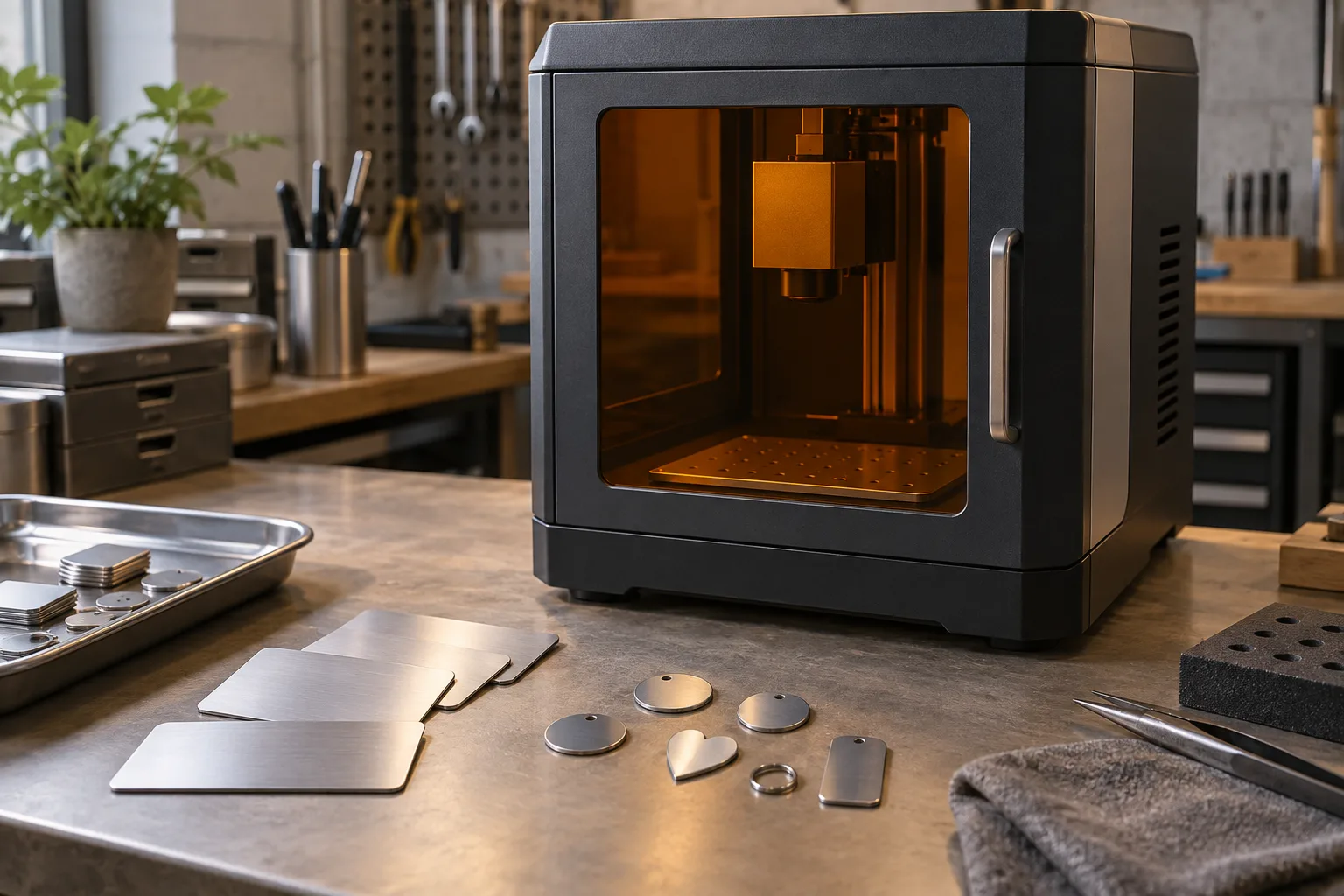
When planning laser engraving metal blanks, include how each blank is located, held flat and checked after processing. A tray can speed up handling only if it keeps every piece in a repeatable position and does not interfere with focus or the machine’s safety enclosure. Small tags, card blanks and curved parts need different stops and clearance.
Jewelry is another small-part workflow. A search for a laser cutter for metal jewelry can mean cutting a profile from sheet stock; that is not the same job as engraving a finished ring, pendant or jewelry blank. Do not assume that a fiber marking system cuts through metal. Confirm the maker’s stated process and material thickness before planning a cut.
Think about aluminum business cards and small runs
For laser engraving aluminum business cards, identify whether the card is anodized, painted, coated or bare. A contrast mark on a surface layer may be a different process from removing material from aluminum. Ask for a sample from the same card stock and check fine lettering, QR codes, edge margins and post-mark cleanup.
A laser engraving small business also needs a practical job flow: file intake, customer proof, material confirmation, fixture loading, process record and final inspection. Record the actual time for setup, marking, cleanup and rework before estimating capacity. This guide does not predict sales, payback or product demand.
Compare safety, support and ownership
Check the product hazard class and labels, guarding, interlocks, emergency stop, required operator training, installation space and extraction instructions. FDA notes that Class IV products can create immediate eye and skin hazards and a fire hazard; OSHA recommends enclosing laser operations and identifying appropriate safeguards. Confirm that the enclosure and accessories are part of the offered configuration rather than an optional item omitted from a product image.
Ask about lens or source service, replacement parts, software support, training, electrical requirements and the maintenance schedule. Compare total shop fit and support in writing. Current campaign status, approved linking routes and affiliate tracking have not been checked, so this page is informational and has no paid recommendations.
References: Trotec’s laser-marking overview, Trotec metal-marking comparison, FDA laser classes and OSHA machine safeguards.
Fiber laser buying comparison
| Compare | Evidence to request | Decision it supports |
|---|---|---|
| Material and mark | Sample on the exact grade, finish and blank. | Confirms process fit and visible result. |
| Work envelope | Usable field, focus range, fixtures and optional rotary. | Confirms parts fit and can be located. |
| Workflow | Software, file handling, alignment and inspection. | Shows how repeat jobs will be controlled. |
| Safety and support | Labels, guarding, interlocks, extraction, training and service. | Shows what is needed to operate and maintain the setup. |
Before you compare machines
- Ask for a sample on the exact metal, finish and part shape.
- Compare field, focus, fixture and workholding before power claims.
- Separate engraving from marking, coating removal and through-cutting.
- Confirm machine class, enclosure, training, extraction and service support.
Questions worth answering first
Is a fiber laser the best engraver for every metal?
Fiber is a common choice for metal marking, but the right result still depends on the material, finish, process, field, optics and fixture. Request a documented sample for the exact part.
Can a fiber laser cut metal jewelry blanks?
Do not infer a cutting capability from a marking specification. Cutting through a sheet is a different requirement; check the exact machine documentation and suitable process before planning it.
Should a small business buy a laser before testing its material?
A sample-first evaluation reduces uncertainty about contrast, detail, cleanup and fixturing. Confirm material compatibility and the complete installation requirements before purchase.