Choose the result before the laser type
“Engraving” is often used as a catch-all, but metal workflows can create a surface color change, remove a coating, or remove material to form a recess. Those marks have different appearance, depth, cleanup and durability. Ask the shop or product maker to describe the process in terms of the finished surface rather than relying on one marketing label.
Stainless grades, brushed or polished finishes, coatings and heat history can all change the result. A sample made on one data plate does not establish compatibility with every stainless-steel part. Keep the material traceable and request the maker’s material-specific guidance.
Match the source to bare or coated steel
Fiber laser systems are a common starting point for direct marking on metal, but the useful comparison is still the exact source, optics, field size, focus range and documented process. Trotec describes fiber workflows for stainless and also notes that a CO₂ system may need a compatible marking solution for blank metal. This is a process distinction, not a promise that one laser category will handle every finish or mark.
For a coated tag, the job may be to remove or alter the coating rather than mark the base metal. Confirm the coating composition, contrast, residue and cleanup requirements with the supplier. Do not infer that a bare-metal setting or a result on a different alloy transfers to that tag.
See the fiber laser guide for a machine comparison framework and the manufacturer’s CO₂-versus-fiber metal-marking explanation for an example of why the process matters.
Plan stainless steel tags as a repeatable job
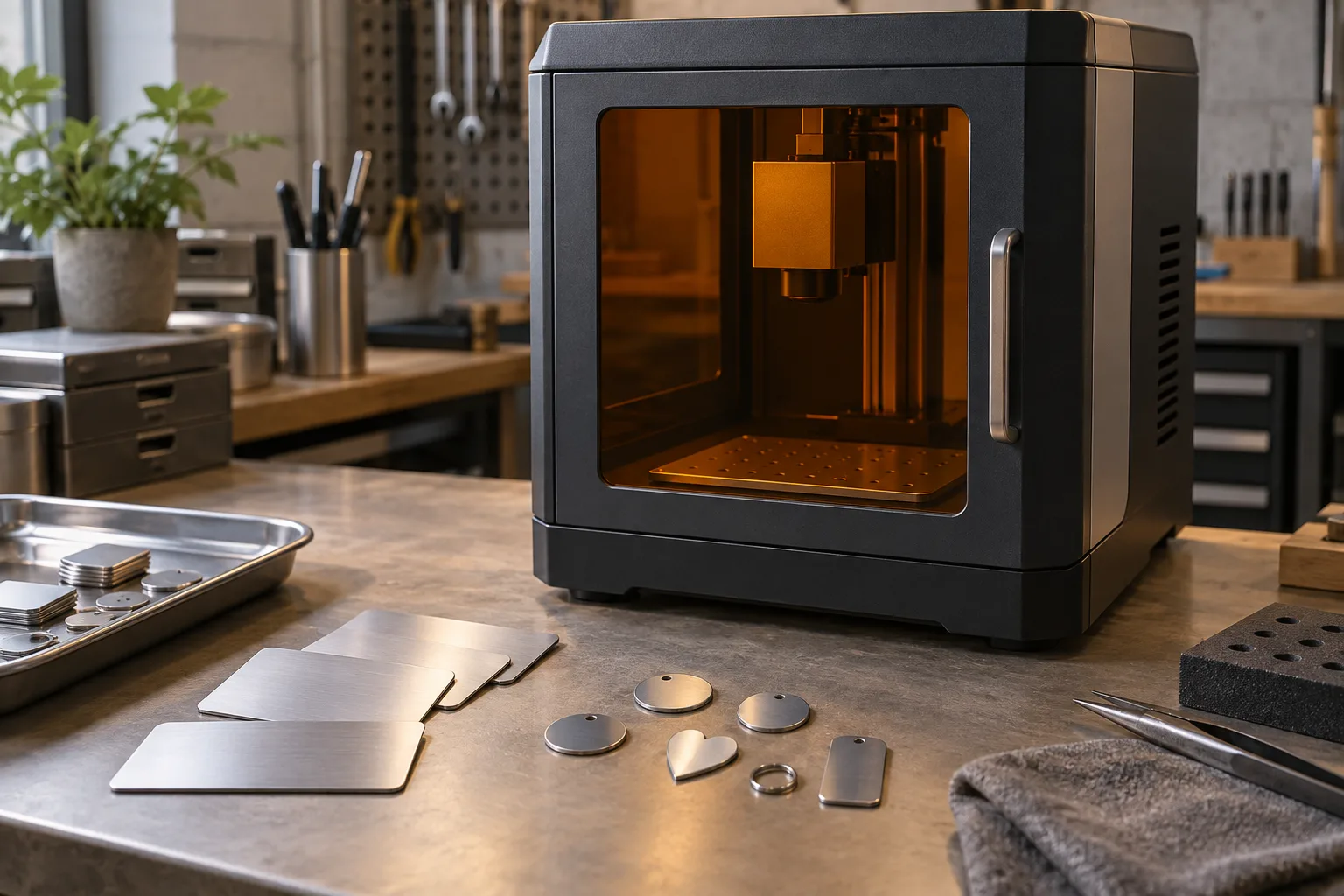
A laser engraver for stainless steel tags needs enough usable field for the blank, a fixture that registers its edges and a layout that respects any hole, corner radius or keep-out area. Decide the smallest serial number or line of text that must remain legible. Test the intended font, logo and code on a sample from the same finish before loading a batch.
For production tags, document blank source, orientation, fixture stops, file version, inspection method and the result the customer approved. A template that looks centered on screen can shift if the tag rotates or sits against a different edge stop.
Check enclosure, labels and extraction
Laser safety depends on the complete product and installation, not its color or how bright the beam looks. Read the hazard class and output information on the actual machine, confirm the enclosure and interlocks are intended for the system, and follow the maker’s operating and maintenance instructions. FDA notes that Class IV products can present immediate eye and skin hazards from direct or reflected exposure as well as a fire hazard; OSHA likewise advises enclosing laser operations and applying appropriate safeguards.
Marking, coatings and cleanup can create smoke or residue. Follow the equipment and material supplier’s instructions for source capture and discharge, and keep the work area under observation. For workplace use, consult the applicable safety program rather than treating this buying guide as an operating procedure. See the FDA laser-class overview and OSHA laser-operation guidance.
Stainless-steel machine shortlist
| Decision | What to verify | Why it matters |
|---|---|---|
| Base material | Grade, coating, finish and supplier documentation. | A sample from a different surface may not transfer. |
| Mark type | Surface color, coating removal or material removal. | The visible result and cleanup differ. |
| Part handling | Tag size, holes, fixture stops and focus range. | Registration controls legibility and repeatability. |
| Safety system | Hazard class, enclosure, interlocks and capture plan. | A complete machine setup must control beam and process hazards. |
Before you compare machines
- Name the stainless grade or source and the exact surface finish.
- Specify color marking, coating removal or material removal.
- Measure tags, keep-out areas, fixture stops and smallest readable detail.
- Check machine labels, enclosure, interlocks and the supplier’s process guidance.
Questions worth answering first
Can a diode laser engrave stainless steel tags?
Some diode workflows are documented for particular coated surfaces or marking compounds, but that is not the same as a universal direct-marking capability on bare stainless. Check the exact machine and tag documentation before selecting the process.
Is a fiber laser always the best laser engraver for stainless steel?
No single source is best for every finish, mark, part size or budget. Fiber is a common route for direct metal marking, but the machine still needs documented compatibility and a fixture that suits the work.
Does laser engraving cut through a stainless tag?
A marking or engraving machine should not be assumed to cut a metal tag. Cutting is a different process and capability; confirm the machine maker’s stated use for the exact material and thickness.