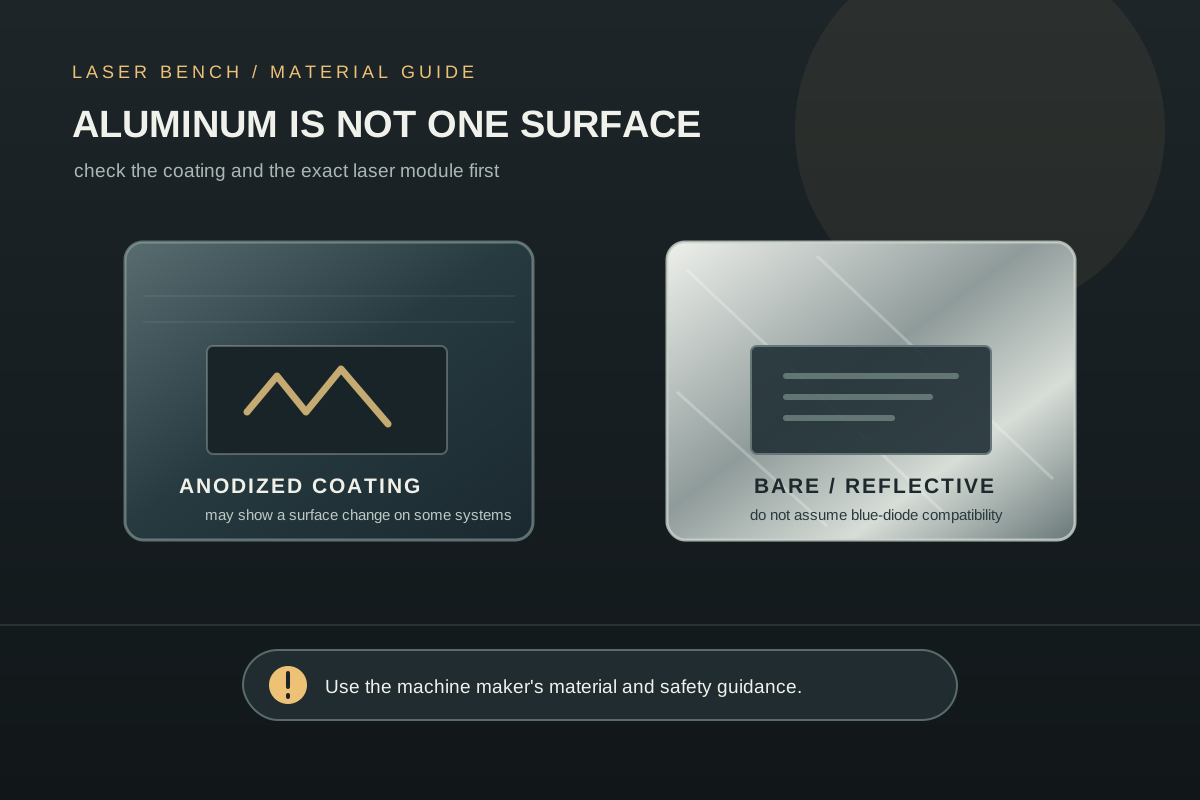
Anodized aluminum and bare aluminum are different jobs
Anodizing creates an oxide layer on the aluminum surface. A blue diode can change or lighten that surface layer on some machine-and-material combinations, leaving a contrast mark. The result depends on the anodizing color and thickness, alloy, module, focus and process; a light surface change is not the same as cutting or deeply engraving the metal itself.
Bare, mirror-finished or otherwise highly reflective aluminum is a different case. xTool’s current M2 FAQ warns that its blue-light module is not suitable for highly reflective materials such as unoxidized aluminum, while its M2 material guide describes anodized aluminum as a surface that may be lightly etched or bleached. These are model-specific examples, not a compatibility guarantee for every diode laser.
Do not mix blue diode, infrared and fiber guidance
“Diode laser” is not a universal metal process. A blue diode, a 1064 nm infrared module and a fiber marker differ in wavelength and intended materials. Manufacturer literature may support a metal workflow for one module in a product family while explicitly warning against it for another. Confirm which head is installed and read the documentation for that exact model.
Do not use a coating or marking compound as a shortcut unless both the laser maker and compound maker allow that combination and you can follow their enclosure, extraction and cleanup instructions. Do not infer material safety from a dark color, a marketplace title or one successful video.
A safe, repeatable decision workflow
- 01Name the surface.
Ask the supplier whether the blank is anodized, painted, powder-coated, plated or bare. Keep the material sheet and finish with the job notes.
- 02Check the exact laser source.
Match the machine model, installed module and documented operation to the material. A compatibility note for an infrared or fiber head does not authorize a blue-diode process.
- 03Use a matching sample.
If the maker documents the material, test a scrap from the same finish and batch using only the maker’s allowed range. Keep the enclosure, interlocks and extraction configured as instructed and supervise the entire operation.
- 04Judge the real result.
Check contrast, edge definition, surface damage and cleanup at the final mark size. A visible mark does not prove depth, durability or suitability for a functional part.
- 05Record and repeat.
Save the model, module, material batch, coating, focus, software units and result. Re-test when any of those inputs change.
Use a material test as a comparison, not a recipe
A software test grid can compare documented settings, but it cannot establish that an unknown aluminum surface is compatible or safe. LightBurn’s Material Test documentation explains how its generator varies parameters such as speed and power. Start only with a range supported by the machine maker, confirm units and preview the job before running it.
For reflective material, the machine maker’s warning takes priority over a test-grid experiment. Do not run an unapproved bare-metal test to discover whether the reflection will be a problem.
When to choose a different process
If the part is bare aluminum, needs a durable or deep mark, or has a finish the diode maker does not document, compare an approved infrared or fiber process or a different industrial marking method. Choose by the required depth, contrast, part geometry, throughput and safety controls. The fiber laser metal guide explains what to verify when a different source may suit the job; its advice still depends on the exact machine and material.
If the part is coated or anodized but the supplier cannot identify its surface treatment, do not assume the coating can safely be removed. Ask for the material and process documentation first.
Sources checked October 1, 2026
xTool M2 FAQ (blue-light module limits for reflective, unoxidized aluminum); xTool M2 material cheat sheet (anodized-surface example and model-specific cautions); LightBurn Material Test documentation (software comparison workflow). Read the current manual for your exact machine and material before starting a job.
What aluminum surface are you working with?
| Surface | What a blue diode may do | First decision |
|---|---|---|
| Anodized aluminum | Some systems may alter or lighten the oxide surface; results vary. | Confirm the exact module and maker-supported material range. |
| Painted or coated aluminum | A documented setup may change or remove a coating; fumes and finish vary. | Identify the coating and follow both manufacturers’ guidance. |
| Bare or mirror-finished aluminum | Compatibility is not implied; reflection and poor absorption can be concerns. | Do not run an unapproved test. Check a documented alternative process. |
Before you compare machines
- Identify the aluminum finish and keep the supplier’s material details.
- Verify the installed laser type and the exact model’s approved material guidance.
- Never copy settings between blue diode, infrared and fiber systems.
- Test only an approved matching sample with the documented enclosure and extraction.
- Record the complete setup; do not treat one mark as a universal preset.
Questions worth answering first
Can a diode laser engrave aluminum?
Sometimes a diode can create a surface change on a compatible anodized or coated blank. That does not mean it can reliably engrave bare aluminum. Check the exact machine and finish documentation.
Can a blue diode laser engrave bare aluminum?
Do not assume so. Bare or mirror-finished aluminum can be highly reflective, and some manufacturers warn against processing it with their blue-light modules. Follow the exact machine maker’s guidance.
What settings should I use for anodized aluminum?
There is no universal speed and power pair. Use only the documented range for your exact machine, module and anodized material, then compare a matching sample under the maker’s safety instructions.
Is anodized aluminum the same as raw aluminum?
No. Anodizing creates a surface oxide layer that can respond differently from bare metal. Identify the finish before choosing a laser process.