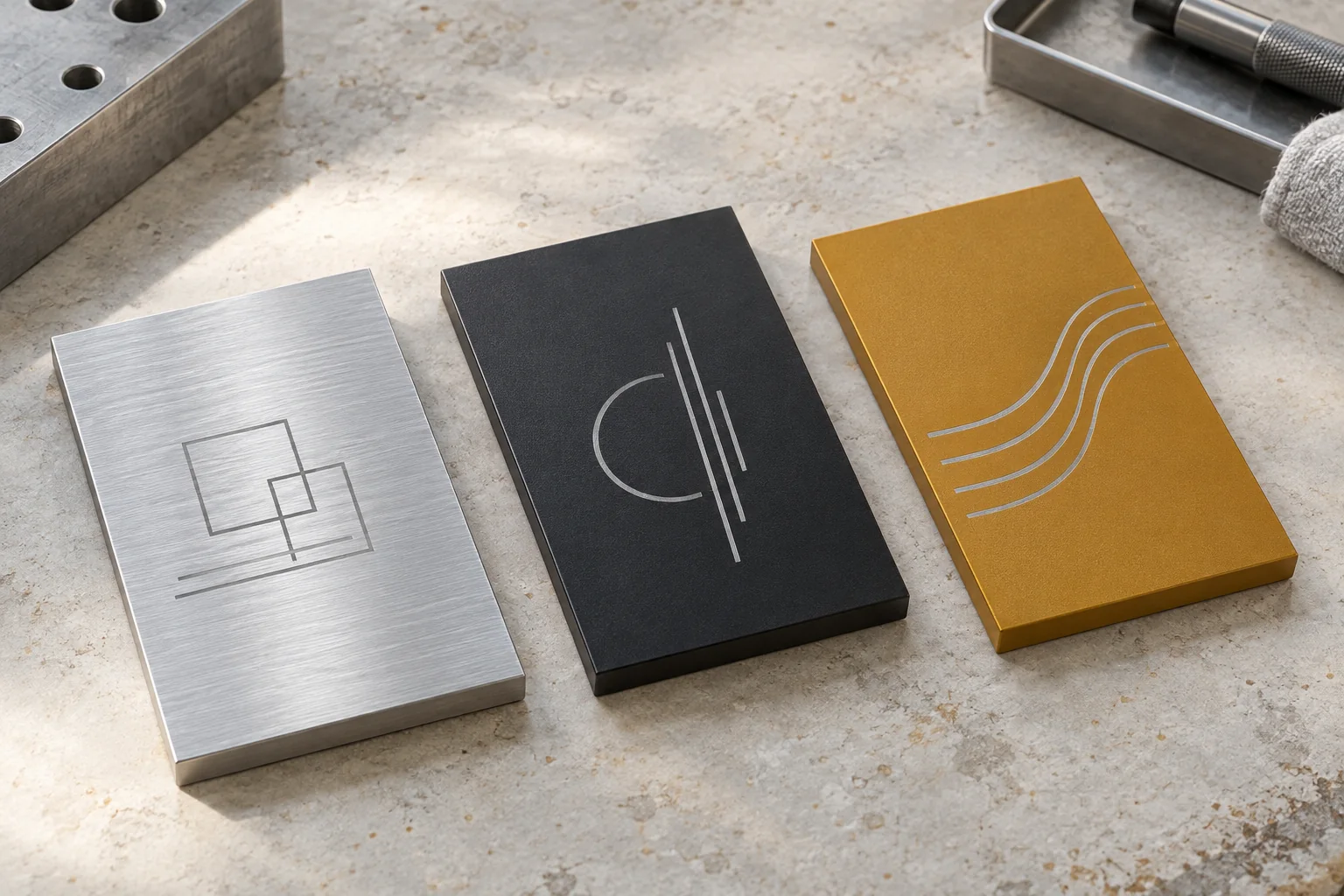
Match the finish to the result first
Use this as a shortlist, then check the exact machine and material combination:
| Your material and goal | What to investigate | What a sample needs to prove |
|---|---|---|
| Bare aluminum with a recessed mark | A fiber engraver rated for the alloy and required depth | Actual depth, edge quality and complete cycle time |
| Bare aluminum with a readable surface mark | Suitable fiber or infrared equipment; an approved marking-compound workflow where supported | Contrast, durability and preparation requirements |
| Black or colored anodized aluminum with light lettering | Compatible CO2, fiber or diode equipment | Contrast and whether the protective finish meets your requirements afterward |
| Powder-coated or painted aluminum | Equipment and coating explicitly approved for laser processing | Clean coating removal, acceptable exposed surface and safe processing |
| Aluminum sheet that must be cut through | A machine explicitly specified for metal cutting at that thickness | Through-cut quality and the required industrial setup |
Manufacturer examples support the distinction: Trotec lists CO2 and fiber options for anodized aluminum, while Epilog's material chart separates coated-metal work from bare-metal marking with a compound. Neither is permission to process an unknown coating.
Identify what is actually on the aluminum
Bare aluminum
A silver appearance is not enough to identify a surface. A part may have clear anodizing, lacquer or another treatment that is difficult to see. Ask the supplier for the alloy and finish description, especially when processing purchased components rather than engraving blanks.
Decide what “engraved” means for the job. A visible logo, a dark identification mark and a recessed character are different acceptance criteria. If depth matters, specify it in a measurable unit and ask how it will be checked. Do not accept a photograph as proof of depth.
Anodized aluminum
Anodizing creates an oxide layer through an electrochemical process. It differs from paint sitting on the surface, as Epilog explains in its anodized-aluminum application guide.
Laser engraving black anodized aluminum often means producing a pale, high-contrast design. That does not necessarily involve removing the entire protective layer. Trotec describes a process that changes the colored surface while removing very little of the anodized layer. Results depend on the finish and process; do not promise unchanged corrosion protection for every machine or setting.
For outdoor labels or customer-specified parts, ask what durability testing or finishing requirements apply. A mark that looks good immediately may still need evaluation for the intended service environment.
Powder-coated and painted aluminum
Here, the intended effect may be selective removal of the coating. The machine is interacting with that coating as well as the substrate. Establish its composition and laser suitability before processing it, including any protective film, adhesive or additional finish.
Unknown recycled panels and unidentified consumer products make poor first samples. Start with material sold for your supported laser process and obtain its safety information. A product being described as “aluminum” tells you little about everything on its surface.
Compare laser sources without treating watts as the whole story
Fiber lasers for direct metal work
A fiber laser engraver for aluminum belongs on the shortlist when your main work is bare-metal marking or engraving. The useful purchasing question is how the complete system handles your alloy, mark and batch size.
Epilog's fiber marking guidebook distinguishes bare and anodized aluminum, notes that appearance varies, and describes multiple-pass deep engraving. Treat its examples as machine-specific guidance, not universal settings or a guarantee of a black mark.
Request the finished sample and a record of the machine configuration used to make it. For a production job, ask for the total time including loading, focusing, processing and unloading. Our fiber-laser buying guide for metal provides additional selection questions.
Compact infrared systems
A compact infrared engraver can be worth considering for small metal personalization jobs. Check the precise source and supported application rather than assuming every machine labeled “infrared” is equivalent to a larger fiber system.
For example, xTool specifies aluminum among the supported metals for the F2's 1064 nm infrared source. This is a manufacturer's capability claim, not an independent performance comparison. Ask about achievable depth, duty cycle, work area and processing time for your design before choosing this category.
CO2 lasers for suitable finishes and marking compounds
CO2 equipment can be a sensible option when anodized tags are part of a broader nonmetal workshop. Verify the particular blank and desired contrast with the machine supplier.
Bare-metal marking compounds are a separate workflow. Epilog explains that a suitable compound can create a bonded surface mark without removing the metal itself. Confirm that the compound supports aluminum and your laser, and follow its application and safety instructions. Do not substitute an improvised chemical spray.
Blue diode lasers for approved coated materials
A diode laser may suit supported anodized blanks, but a demonstration on those blanks does not establish bare-aluminum engraving capability. In its M1 troubleshooting guidance, xTool explains the absorption limitations of that machine's approximately 450 nm source and points users toward appropriate coated metals.
Apply that evidence to the specified model. For any other diode system, check its own documentation and samples. More advertised watts alone do not settle whether the material, wavelength and required result are a good match.
What to check before buying
Work area and part clearance
Measure the entire object, including clamps and any fixture. A logo may be small while the part carrying it is tall, curved or awkward to position. Ask the supplier to confirm that the object fits with the enclosure properly closed and the required focusing distance available.
Fine detail and repeatable placement
Send the smallest text and most demanding artwork you expect to use. Include the actual fonts and final dimensions. If the application involves a QR code, assess it with the devices and lighting that matter to the job. Our QR-code engraving guide covers that separate readability question.
For batches, ask how the fixture locates each blank and how errors are caught. A one-off demonstration does not show whether an operator can load the fiftieth piece consistently.
Software and support
Confirm that your computer, file formats and required software are supported. Ask about offline operation, saved job parameters, software costs, training and access to replacement parts. Run a sample using your own artwork before committing to a workflow that requires repeated file conversion.
The installed cost
Request a complete quote covering the machine, suitable enclosure, extraction or filtration, fixtures, required accessories, delivery and training. Include consumables and maintenance. Compare complete working setups rather than a machine-only price against another supplier's equipped package.
Set up a safe, controlled sample test
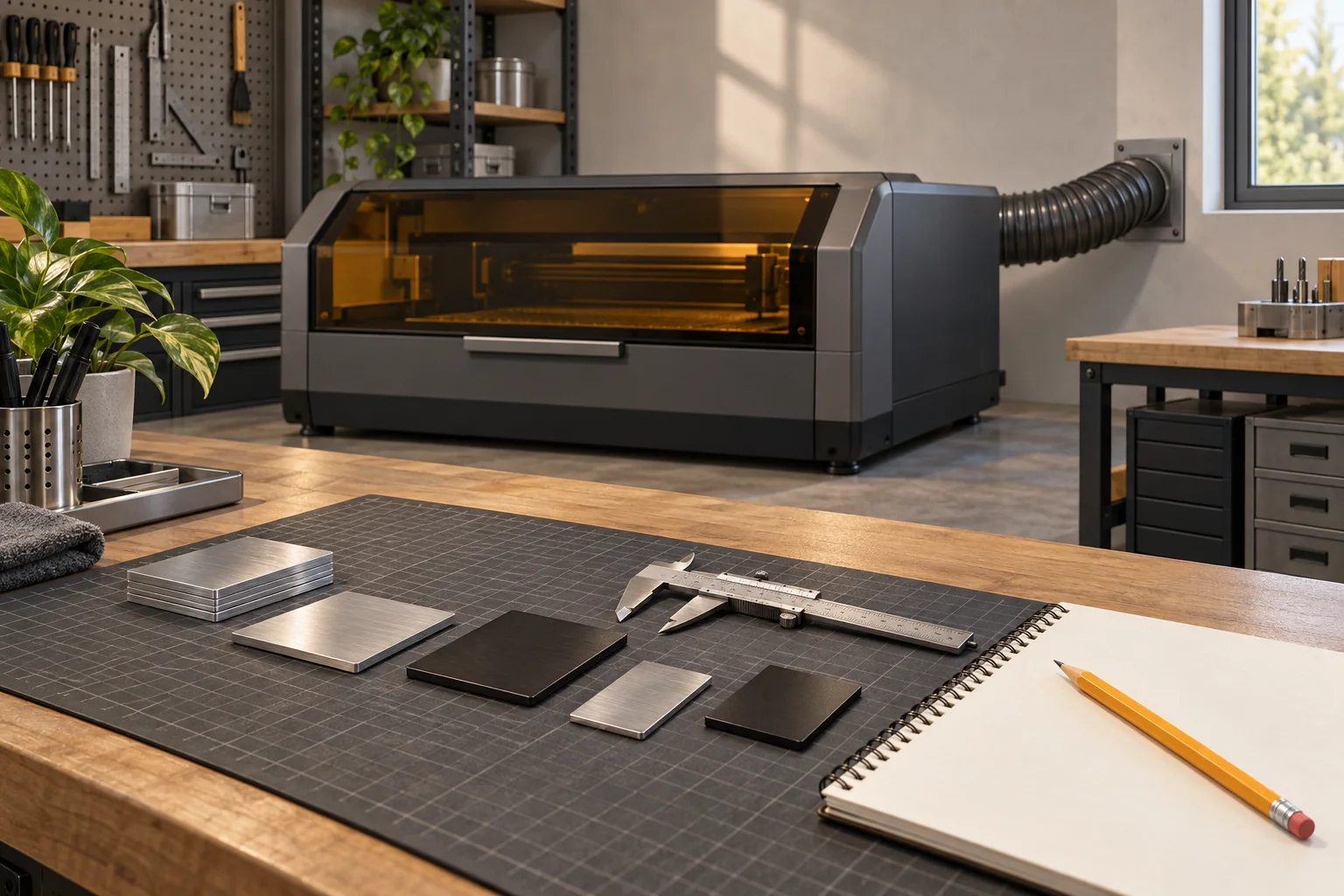
AI-generated workshop illustration. Enclosure, extraction and material approval must be appropriate to the actual machine and process.
Laser safety includes beam exposure, fire and airborne contaminants. OSHA's laser hazard guidance addresses these hazards and the use of engineering controls. Follow the machine manufacturer's instructions and applicable workplace requirements; a generic pair of goggles is not a substitute for a properly designed enclosure and safety system.
Use a preparation sequence that makes the test useful as well as controlled:
- Confirm the material, alloy where relevant, finish and any coating or film. Stop if the composition or compatibility remains unknown.
- Read the machine and material instructions. Use the approved enclosure and extraction arrangement; keep interlocks intact.
- Secure a sacrificial sample using a suitable fixture, with the part correctly positioned and focused.
- Begin with the manufacturer's guidance for that machine and material. There is no universal aluminum power-and-speed recipe.
- Make a small, labeled test grid within the permitted operating range. Keep changes systematic so you can tell what affected the result.
- Inspect contrast, edge definition and the required depth or readability. Save the result alongside the material batch and settings.
Keep the system attended and the work area clear of combustibles. Epilog's fire-safety guidance also emphasizes cleaning and exhaust maintenance. Review our laser exhaust-system guide when planning the installation.
The laser engraver test-file guide can help organize sample comparisons. Use it alongside the manufacturer's instructions, not in place of them.
Why an aluminum mark looks faint or inconsistent
Start with a diagnostic question rather than immediately increasing power:
- Did the material change? Check the supplier, finish and batch against the successful sample.
- Is focus correct across the design? A tilted or curved part may need a different approved setup.
- Is the result being judged consistently? Compare samples under the same lighting and viewing angle.
- Are you using the intended laser source? A dual-source machine may require a different source for this material.
- Is the machine maintained? Follow its prescribed cleaning and inspection procedure.
- Are you trying to obtain depth from a coating-only process? Revisit the material-and-result choice before spending more time on settings.
If a known-good sample stops working, document what changed and contact support. Avoid escalating to repeated aggressive passes on a valuable finished part.
The buying checklist
Before ordering, make sure you can answer five questions: What is the exact finish? What must the mark achieve? Has the supplier demonstrated that result on a matching sample? Does the complete part fit safely? What does the fully equipped workflow cost?
Those answers are more useful than the largest wattage number on a listing. Choose the system that meets your documented aluminum job, then keep the approved sample as the benchmark for future work.
Questions worth answering first
Can a diode laser engrave aluminum?
Some diode systems can create useful designs on supported anodized or coated aluminum. Direct engraving into bare aluminum is a different requirement. Ask for the exact machine's documented support and a sample matching your finish and intended depth.
Can a CO2 laser mark bare aluminum?
A compatible marking compound may enable a surface mark when the machine and compound manufacturers approve the combination. That bonded mark does not demonstrate removal of the aluminum substrate. Read the compound's instructions before treating the job as routine CO2 engraving.
Will engraving always remove the anodized layer?
No. Some processes primarily change the colored appearance while leaving most of the protective layer intact. Others can remove material. If protection matters, qualify the actual process and finished part rather than relying on the word “engraving.”
Does deep engraving mean the machine can cut aluminum?
No. Buy against an explicit metal-cutting specification for your material and thickness. Our engraver-versus-cutter guide explains why these capabilities need separate evaluation.