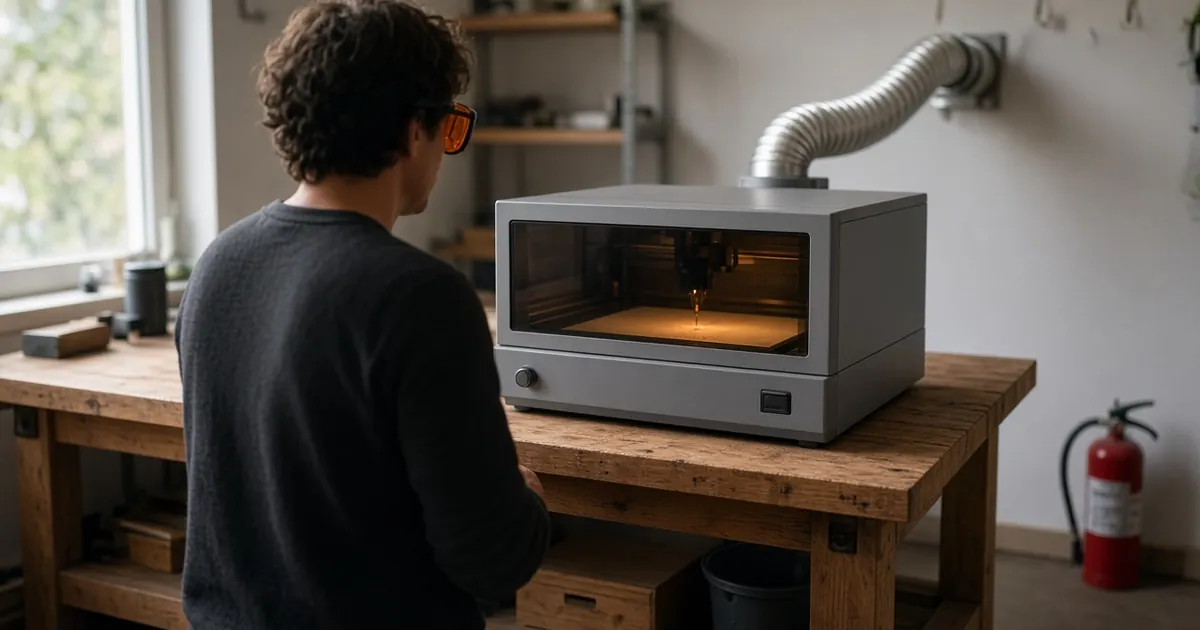
Quick picks: laser safety glasses by laser type
We picked one pair per laser type, because the right pair depends on which laser you own. We didn't lab-test these glasses. The picks are based on the wavelength and OD markings shown on each listing. Check the variant you select and the markings on the lenses when the pair arrives.
Diode lasers (445–455 nm): 450 nm laser safety goggles, Style C
For blue diode engravers. This listing mixes 450 nm and 1064 nm variants (the title shows "1064nm 450nm" and "OD4+ OD8+"), so choose the 450 nm variant. Before you order, confirm the OD stated for 450 nm on the variant you picked. OD4+ is the bare floor for a 10W diode in our worked example below. For 10W and up, we'd want OD5+ printed on the lens.
CO2 lasers (10,600 nm): Cloudray Style F, OD6+ at 10.6 µm
For CO2 engravers and cutters. The listing names 10,600 nm (10.6 µm) and OD6+, the wavelength and protection level most CO2 hobby and small-shop machines call for. It's a CO2-only pair: it won't protect you from a diode or fiber laser.
Fiber lasers (1064 nm): Cloudray Style B, 940–1100 nm OD6+
For fiber marking lasers. The listing names a 940–1100 nm band at OD6+, which covers the 1064 nm wavelength of standard fiber lasers, and its listing shows a CE mark. Use it for 1064 nm only, not for blue diodes or CO2.
Still choosing the machine itself? Start with our best laser engraver for beginners guide, then come back here with its wavelength.
What laser safety glasses actually do
A laser engraver's beam is far brighter than anything your eye can handle. Hobby diode, CO2 and fiber engravers are generally Class 4 lasers when the beam is open. A direct hit, or a sharp reflection off a shiny part, can injure the retina faster than you can blink. Laser safety glasses carry filters that absorb or reflect a specific band of wavelengths and let other light through, so you can still see your work.
Three ideas decide whether a pair protects you:
- Wavelength range. Each lens is built for a band, such as 190–540 nm or 940–1100 nm. Outside that band it may offer little or no protection.
- Optical density (OD). How strongly the lens cuts the laser's light inside that band.
- Damage resistance. How long the lens survives a direct hit before it burns or bleaches through. This is what the EN 207 "LB" rating describes.
How to choose laser safety glasses
1. Find your laser's exact wavelength
The wavelength is printed on the warning label on your machine and in its manual. Typical values:
| Laser type | Typical wavelength | Can you see the beam? | What usually blocks it |
|---|---|---|---|
| Blue diode | 445–455 nm | Yes, bright blue | Orange, red or amber lenses rated for that band |
| CO2 | 10,600 nm (10.6 µm) | No (far infrared) | CO2-rated lenses, often clear or lightly tinted |
| Fiber (galvo marker) | 1064 nm | No (near infrared). The red dot is only the aiming beam. | Lenses rated for about 1064 nm, often green or teal |
| Infrared diode module | Around 1064 nm (check yours) | No | Lenses rated for that exact wavelength |
Some diode machines also offer swappable infrared modules. If you run both a blue and an infrared module, you need a pair covering both bands, or two pairs.
If you're still deciding between laser types, our laser engraver vs laser cutter guide covers what each one does well.
2. Work out the OD you need (the simple version)
OD is a log scale. Each step is a tenfold cut in the light that gets through:
| OD | Fraction of the laser light that gets through |
|---|---|
| OD2 | 1 in 100 |
| OD4 | 1 in 10,000 |
| OD5 | 1 in 100,000 |
| OD6 | 1 in 1,000,000 |
The required OD is the base-10 log of how many times stronger the beam is than the maximum permissible exposure (MPE), the level safety standards treat as safe for the eye. In formula form, OD = log10(beam exposure ÷ MPE).
Worked example: a 10W blue diode. Assume all 10 W could enter a fully open 7 mm pupil, an area of about 0.385 cm². That's roughly 26,000 mW/cm². For accidental exposure to visible light, ANSI Z136.1 assumes you blink or turn away within 0.25 s, which gives an MPE of about 2.5 mW/cm². 26,000 ÷ 2.5 is about 10,000, so the minimum is OD4. Double the power to 20 W and you need about OD4.3. That's why OD5+ is a common target for hobby diodes: it covers the math with margin, and longer exposures or higher powers push the number up.
You don't need to do this yourself for every laser. If the machine's manual names an OD, use that. If not, use the table in the comparison section below as a starting point and err on the high side. Don't push OD far beyond what you need, though. Very dark lenses make it harder to see the workpiece, and people who can't see tend to lift their glasses.
3. Check the damage rating, not just OD
OD alone doesn't tell you how long the lens survives a direct hit. Lasermet's guide to EN 207 gives a stark example: polycarbonate eyewear with OD greater than 6 at 10,600 nm on paper can start burning immediately under a direct CO2 beam of just 20 W. EN 207 addresses this by testing the filter and the frame against a real beam. Its markings look like this:
- D 445–455 LB5 – continuous-wave (D) protection, wavelength band in nm, scale number LB5
- I, R and M – pulsed modes (long pulse, Q-switched, ultrashort). Many fiber markers are pulsed, so the R rating matters for them.
A higher LB number means the lens withstands a higher power density. In the US, ANSI Z136.1 sets out how to choose eyewear by wavelength and OD, and the lens should be marked with both. When a listing says a pair meets one of these standards, look for those markings on the lens or frame itself.
4. Check visible light transmission (VLT)
VLT is the share of ordinary visible light that passes through the lens. A higher VLT gives a brighter, easier view of your work. Blue-diode lenses absorb blue light, so the room looks orange or amber through them, and colors on the workpiece shift. That's normal. If a listing quotes VLT, a higher number at the same OD and wavelength is more comfortable for long jobs.
5. Pick glasses or goggles that fit
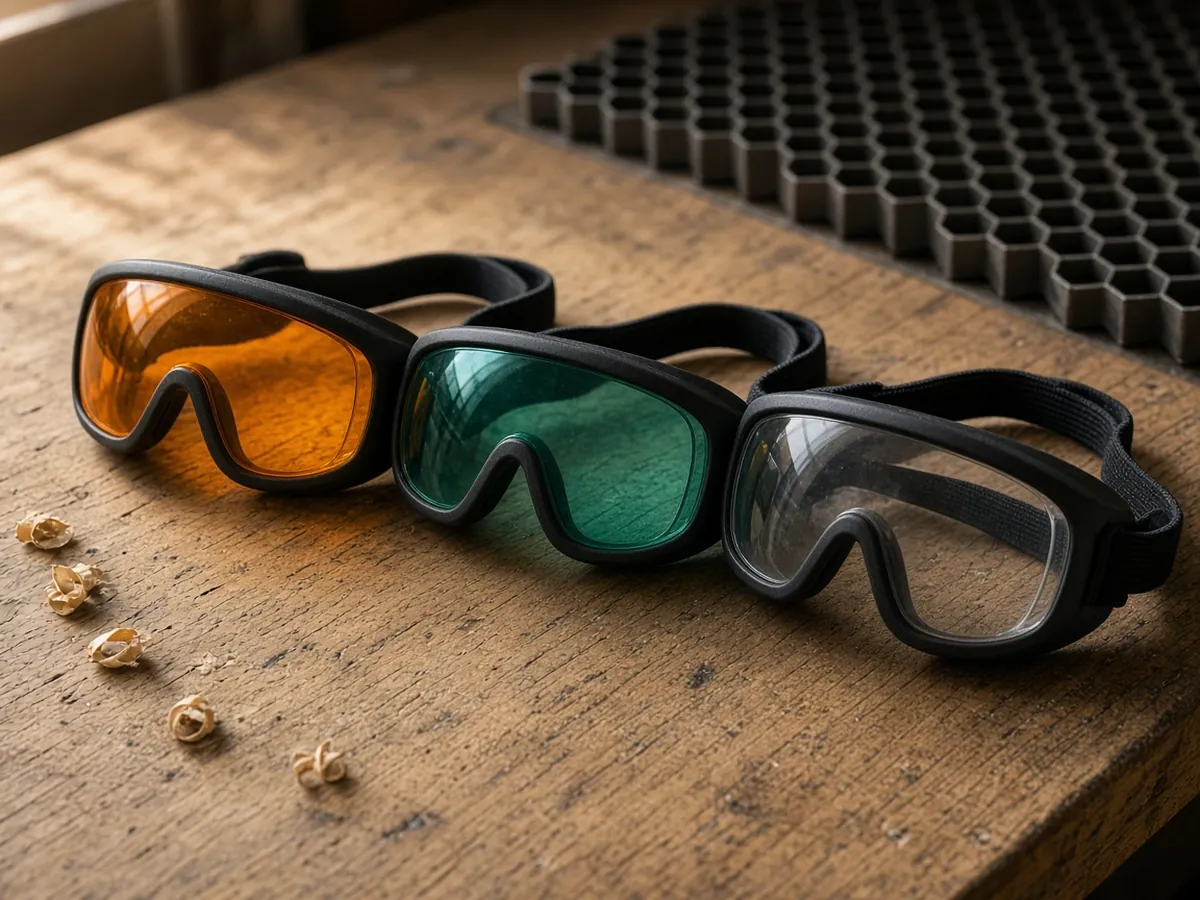
- Glasses (spectacle style) are lighter and more comfortable for long jobs, but they need side shields so reflections can't come in from the side.
- Goggles seal around the eyes and usually fit over prescription glasses. If you wear glasses, check the listing photos and measurements, or buy an over-glasses (OTG) frame.
- Fit check: the frame should sit snugly without gaps at the sides or top, and it shouldn't slide down when you lean over the machine.
Why the glasses from a cheap kit may not be enough
Many budget diode kits ship with a pair of tinted glasses. Some are fine, but plenty have no wavelength or OD marking at all. A few warning signs:
- No markings on the lens or frame. If you can't read a wavelength band and an OD on the glasses themselves, treat them as unrated.
- The wrong color. Clear or blue-tinted lenses let blue light through by design, so they can't be meaningful protection against a 450 nm diode. Green lenses are usually made for infrared lasers such as 1064 nm, not for blue.
- Implausible claims. A thin, cheap lens claiming very high OD from deep ultraviolet to far infrared deserves suspicion. Real broadband filters exist, but they're specialist items.
- Markings only on the box or listing. The protection has to be identifiable on the eyewear you're wearing.
The same goes for the tinted acrylic shroud on a diode laser module and for ordinary sunglasses. Neither is rated eye protection. The shroud cuts some scattered light near the head, and that's all you should expect from it.
Laser safety glasses vs an enclosure
Eyewear is the last line of defense. Order matters:
- Enclosure and interlocks. A machine built as a closed Class 1 system, with a lid that stops the laser when it opens, protects everyone in the room. If your machine has interlocks, never bypass them. For open-frame diodes, an enclosure with a viewing window rated for your laser's wavelength is the biggest safety upgrade you can make.
- Habits. Keep your face out of the beam path, remove shiny jewelry and tools from the bed, and never run the laser unattended.
- Glasses. Wear them whenever the beam can escape: open-frame machines, lid-open work, focusing, alignment and maintenance.
A machine's own window is not automatically rated either. Acrylic lids on CO2 machines absorb 10,600 nm well, but ordinary clear acrylic or glass passes blue diode and 1064 nm fiber light. Check the manufacturer's documentation for the window's rating.
Ventilation is a separate job. Glasses do nothing about smoke, so pair them with a proper exhaust system.
Laser safety glasses by laser type
Diode laser safety glasses (445–455 nm)
Most hobby diode engravers, the kind used for engraving wood, leather and coated metal, are open-frame machines with a bright blue beam. Reflections off the bed, the workpiece or a metal tumbler are the realistic hazard. Choose lenses marked for at least 445–455 nm, at OD5+ for 10W-class modules, and make sure everyone else in the room wears a matching pair too.
CO2 laser safety glasses (10,600 nm)
CO2 lasers emit far infrared you can't see. CO2-rated lenses are often clear or only lightly tinted, because many plastics absorb 10,600 nm strongly. That's also why you shouldn't judge laser eyewear by color. Most CO2 machines are enclosed, so you'll mainly wear the glasses during mirror alignment, lid-open work or maintenance. CO2 glasses don't protect against diode or fiber lasers. If you engrave glass with a CO2, our glass engraving guide covers the rest of a safe setup.
Fiber laser safety glasses (1064 nm)
A fiber marker's working beam is invisible, and the red dot you see is only a low-power aiming beam. Many desktop galvo fibers have no enclosure, and metal parts reflect strongly. Wear glasses rated for 1064 nm every time the laser can fire, and check for a rating for pulsed operation (the R mode in EN 207) if the maker publishes one. More on choosing the machine itself is in our fiber laser checklist.
Comparison table: laser safety glasses picks
| Laser type | Wavelength to match | Suggested minimum OD | Our pick | Listing markings | Shop |
|---|---|---|---|---|---|
| Blue diode (5–20W class) | 445–455 nm | OD5+ (OD4 is the floor for ~10W) | 450 nm laser safety goggles, Style C | 450 nm and 1064 nm variants; OD4+ and OD8+ in the title. Choose the 450 nm variant. | Check price |
| CO2 | 10,600 nm | OD6+ is a sensible target | Cloudray Style F | 10.6 µm (10,600 nm), OD6+ | Check price |
| Fiber (galvo) | 1064 nm | OD6+ is a sensible target | Cloudray Style B | 940–1100 nm, OD6+; CE mark shown on the listing | Check price |
These OD values are starting points for typical hobby and small-shop machines, not a substitute for your laser's manual. Higher-power machines can need more.
Glasses for people watching
Anyone in the room while an open laser runs needs their own matching pair, not just the operator. That includes helpers, customers watching a demo and older kids. Keep a spare pair for each laser type on a hook by the machine. Pets can't wear glasses, so keep them out of the room while an open-frame laser runs. Our accessories guide lists the rest of a safe starter kit.
Care, inspection and when to replace
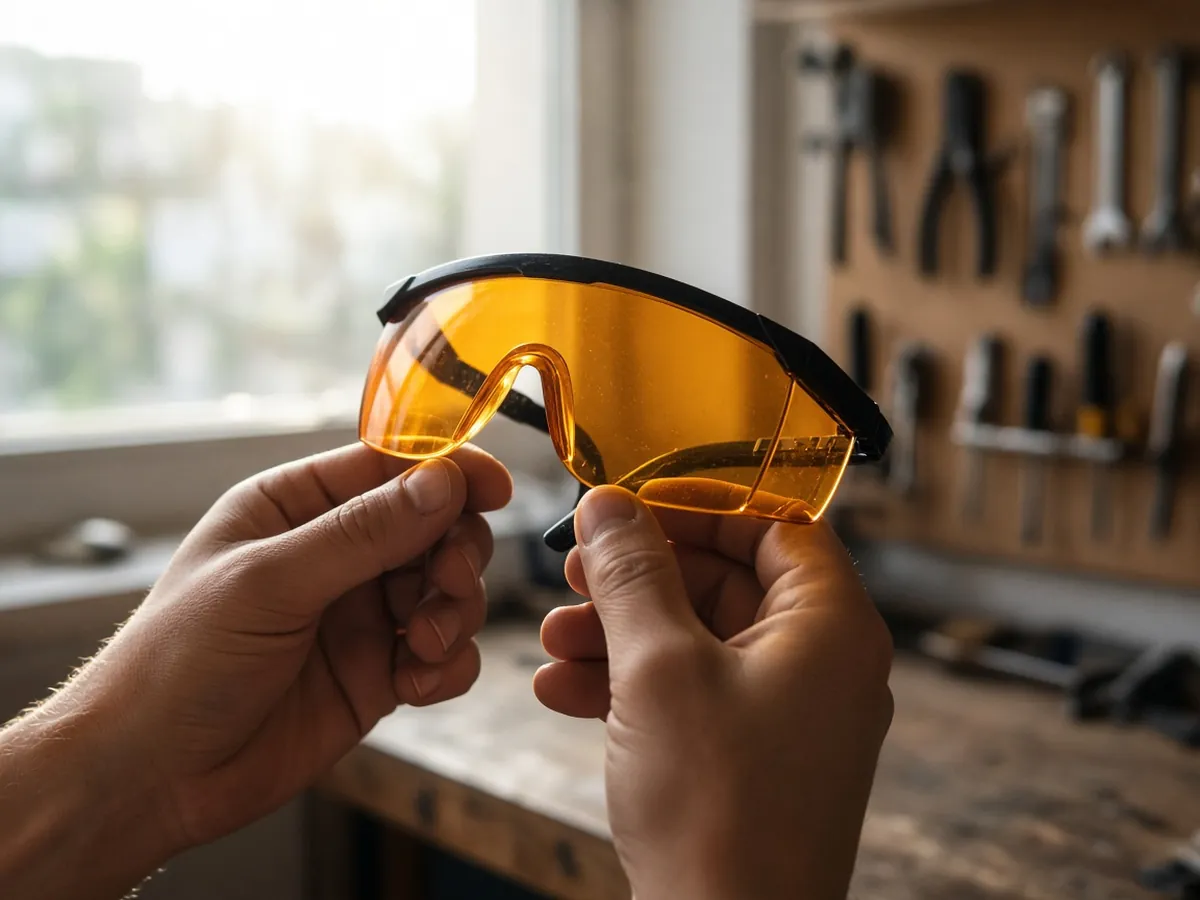
- Before each use: check that the wavelength and OD markings are still legible, and look for scratches, pits, cracks or discolored patches. Make sure the frame and strap still hold.
- Clean gently: rinse dust off first, then use mild soap and water or a lens cloth. Avoid solvents unless the maker approves them. Some can damage the filter.
- Store them protected: keep them in a case or pouch away from heat and direct sun, not loose on the laser bed.
- Replace them if a beam ever hits the lens, if the markings wear off, or if the lens is cracked, crazed or discolored. A lens that has stopped a direct hit may be damaged even if it looks fine.
Add the glasses check to your regular machine maintenance routine.
Laser safety glasses FAQ
Do I need safety glasses for a diode laser engraver?
Yes, for any open-frame diode engraver. The blue beam and its reflections can injure your eyes in a fraction of a second. Wear glasses rated for your laser's wavelength (usually 445–455 nm) with OD5 or higher whenever the laser can fire, and make sure anyone else in the room does too.
What OD do I need for laser safety glasses?
It depends on the laser's power and wavelength. As a rough guide, a 10W blue diode needs at least OD4 by the standard math, so OD5+ gives a margin. OD6+ is a sensible target for CO2 and fiber machines. If your machine's manual names an OD, follow it.
Can I use CO2 laser safety glasses with a diode laser?
No. CO2 glasses are made for 10,600 nm and often have nearly clear lenses that let blue 450 nm light straight through. Each pair only protects within the wavelength band printed on it.
Are green-lens glasses safe for blue lasers?
Usually not. Most green lenses are made for infrared lasers such as 1064 nm fiber lasers. Glasses for blue diodes typically look orange, red or amber. Ignore the color, though, and read the markings: the lens must show a band covering 445–455 nm and an OD rating for it.
What is the difference between laser safety glasses and laser safety goggles?
Glasses look like spectacles and need side shields. Goggles wrap around the eyes, seal better at the sides and usually fit over prescription glasses. Both protect equally if they carry the same wavelength and OD rating. Choose the one that fits you well enough that you'll keep it on.
Do enclosed laser engravers need safety glasses?
A fully enclosed machine with working interlocks is designed so no one needs glasses while the lid is closed. Wear rated glasses whenever you open the lid with the laser powered, during alignment or maintenance, or if the viewing window isn't documented for your laser's wavelength.
How do I know if laser safety glasses are fake?
Check for a wavelength band and OD printed on the lens or frame itself. Be wary of glasses with no markings, of broad claims (very high OD across every wavelength) on a cheap lens, and of standards named in a listing without matching markings on the eyewear.