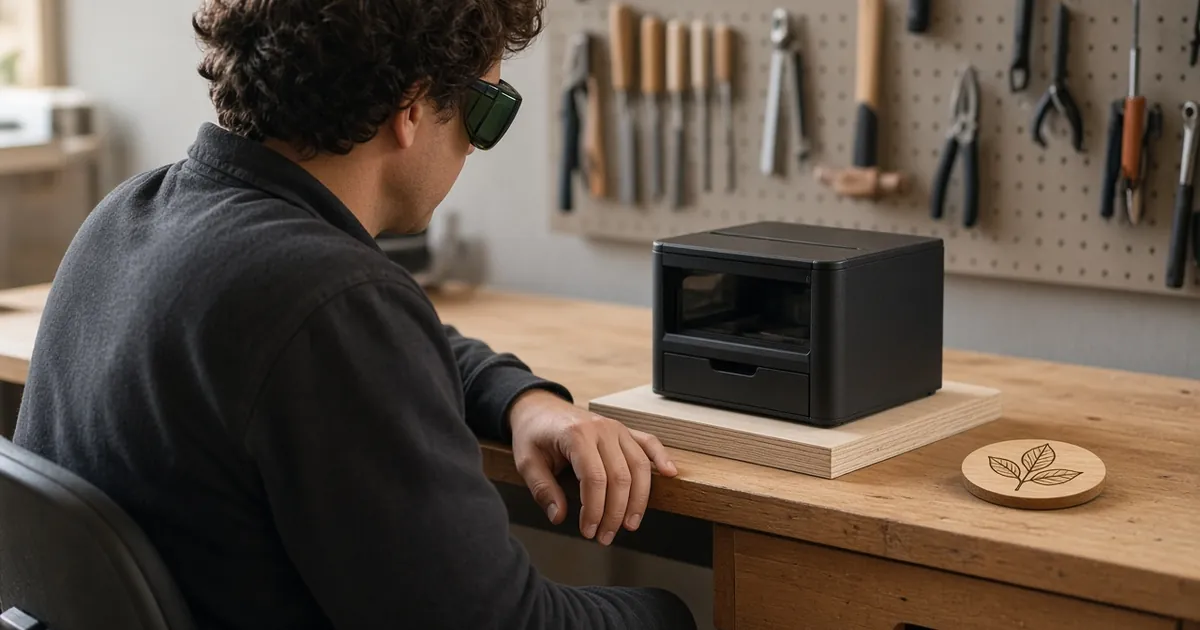
What is a laser engraver pen?
Listings use the phrase for very different tools. Sort the product into one of these before comparing anything else.
Handheld laser pens
A pen- or wand-shaped device with a laser diode in the tip, held and moved by hand. Because there’s no gantry or enclosure, the beam path is open and the mark quality depends on how steady your hand is. FDA explains that hand-held lasers promoted for pointing are limited to Class IIIa, and that Class IIIb products cannot legally be promoted as laser pointers or demonstration products. A handheld unit strong enough to burn wood is a hazardous laser, whatever the listing calls it.
Mini and portable laser engravers
Small, often battery- or USB-powered machines that sit on or above the workpiece and steer the beam with a small motion system or galvo mirrors, controlled from a phone or computer. They’re “portable” in size, but they’re still laser products with a class label, an open or partly shielded beam and fumes to manage.
Rotary or vibrating engraving pens (no laser)
Electric hand tools that mark with a spinning burr or a vibrating carbide or diamond tip. They’re mechanical tools: compare them with rotary tools, not laser machines. They need eye protection against chips, but not laser eyewear.
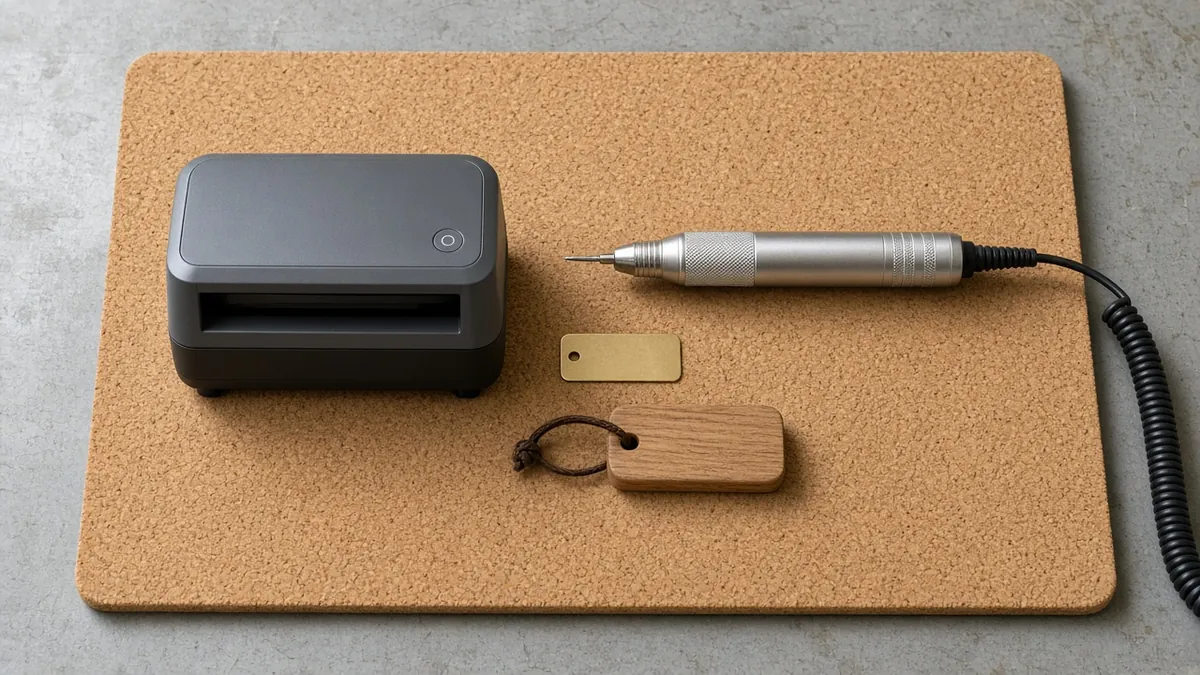
Laser engraver pen vs desktop diode engraver
| Handheld laser pen | Mini / portable laser engraver | Desktop diode engraver | |
|---|---|---|---|
| How the beam moves | Your hand | Small gantry or galvo inside the unit | Gantry over a fixed work area |
| Repeatability | Low, freehand | Moderate, software-driven | High, software-driven with set focus |
| Work area | Unlimited but uncontrolled | Small window | Larger bed; extension kits on some models |
| Enclosure / guarding | Usually none | Varies; often partial shield | Open frame or enclosed, depending on model |
| Focus control | Hand distance | Fixed or adjustable height | Fixed or adjustable, often with a focus tool |
| Fume handling | Hard to capture | Depends on setup | Can be paired with an enclosure and exhaust |
| Best fit | Occasional rough marks, if at all | Small logos and tags on site | Repeatable work on wood, leather, coated blanks |
The table compares categories, not products. Check the specific model’s documentation for its real work area, class, enclosure and accessories. For the difference between marking and cutting capability, see laser engraver vs laser cutter. For why the wattage number alone doesn’t settle it, see what wattage does and does not tell you.
What materials can a laser engraver pen handle?
The laser source and the maker’s documentation decide this, not the pen shape. Small diode-based tools are most often sold for organic materials and coatings. Use this as a starting map and confirm each material with the manufacturer.
| Material | Typical situation with small diode lasers | Check / read more |
|---|---|---|
| Wood, plywood, bamboo | Commonly documented | Species and finish; see diode laser engraver for wood |
| Leather (vegetable-tanned) | Commonly documented | Tanning and finish; see leather settings |
| Cardboard, paper | Often documented | Fire risk; never leave unattended |
| Painted or powder-coated metal | Removes or changes the coating | Coating type; see settings for tumblers |
| Anodized aluminum | Some makers document it | Anodized vs painted; see engraving aluminum with a diode laser |
| Bare stainless steel | Usually needs a fiber laser or marking compound | See laser engraver for stainless steel |
| Glass, ceramic | Maker-specific; risk of cracking | See glass and ceramic |
| Clear or transparent materials | Diode light may pass through | Maker guidance only |
| PVC, vinyl, unknown plastics | Don’t laser | Fumes can be harmful and corrosive; see laser engraver for plastic |
A rotary engraving pen works on a different principle. It scratches or grinds the surface, so it can mark metal, glass and stone, but it produces a hand-made line, not a laser mark.
Power and laser class: read the label
Laser hazard class matters more than how small the tool is. In the US, FDA requires laser products to carry certification and identification labels, and products above the lowest class carry a warning label with the class. Internationally, IEC 60825-1 classifies laser products by their optical radiation hazard.
| US (FDA/CDRH) | IEC 60825-1 | What it means for you |
|---|---|---|
| Class I | Class 1 (also 1M, 1C) | Not hazardous in normal use; enclosed machines with interlocks can be Class 1 even with a powerful laser inside |
| Class II / IIa | Class 2 / 2M | Low-power visible light; blink reflex is the main protection |
| Class IIIa | Class 3R | Up to 5 mW visible; legal limit for pointers. Can cause flash blindness |
| Class IIIb | Class 3B | 5 mW to 500 mW. Direct beam can injure eyes; key switch and remote interlock connector required |
| Class IV | Class 4 | Above 500 mW. Hazardous even from diffuse reflections, plus fire and skin hazard |
Power figures in the table come from FDA’s laser-pointer guidance (Class IIIa ≤5 mW visible; Class IIIb 5–500 mW) and OSHA’s Technical Manual (Class IV above 500 mW, continuous wave).
What this means when shopping:
- A tool that can burn wood is not a low-class laser. If a “pen” listing claims it engraves wood but shows no class, treat that as a red flag.
- Ask for the label itself. The class, wavelength and output should appear on the product’s warning label and in the manual. Don’t infer them from photos or the word “mini”.
- Optical vs electrical power. Some listings quote electrical input power. Ask for the optical output the class is based on.
- Enclosed ≠ open. A fully enclosed, interlocked machine can be Class 1 to the user. An open-frame or handheld tool exposes the full class of its laser.
FDA’s laser FAQ also notes that Class IIIb and IV products should be used only by trained people with a legitimate need. Several states have their own registration requirements for Class IIIb lasers.
Eye protection: OD and wavelength must match
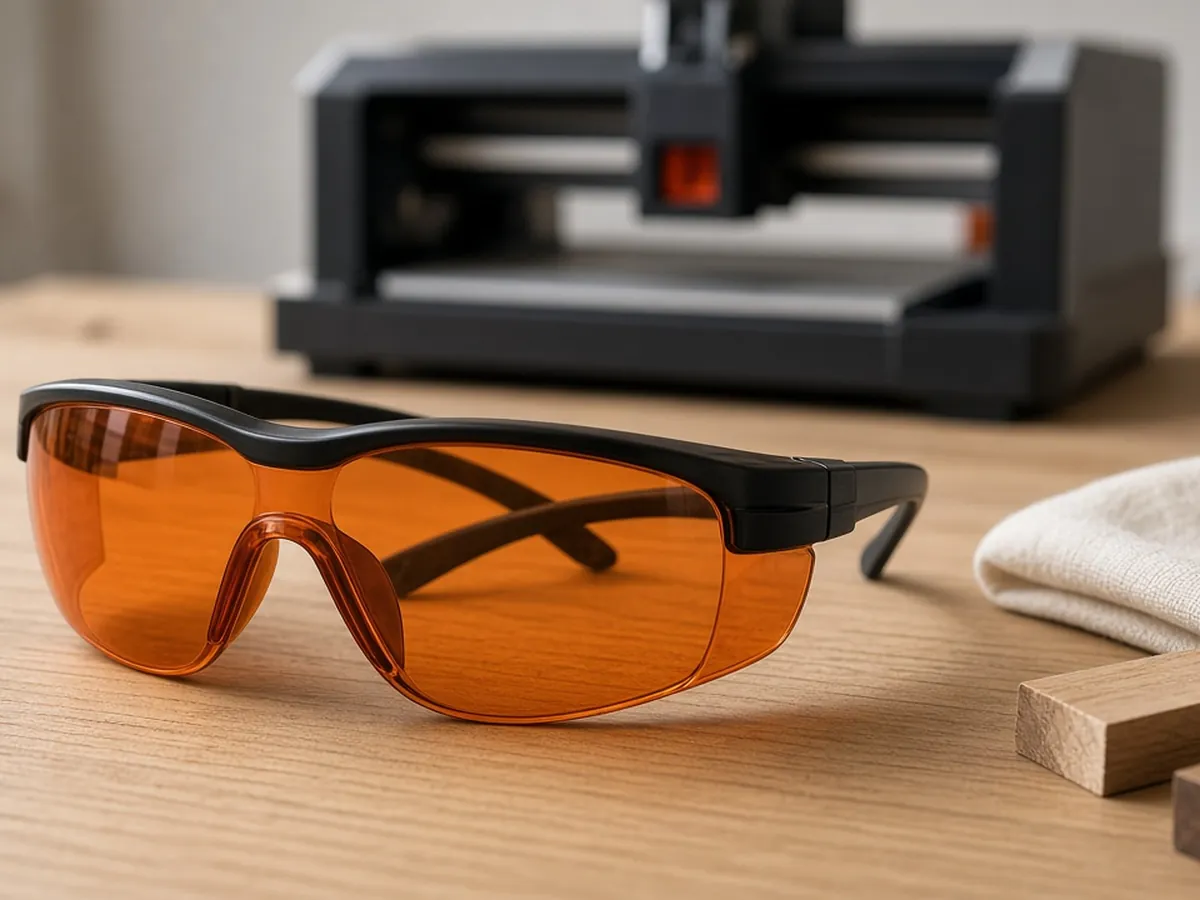
Laser eyewear is not ordinary tinted glasses. OSHA’s Technical Manual states that laser eyewear must be clearly labeled with the optical density (OD) values and the wavelengths it protects against. OSHA’s construction standard requires goggles that protect “for the specific wavelength of the laser” with an OD “adequate for the energy involved”.
- Match the wavelength. Get the wavelength from the laser’s label or manual (for example, a blue-diode wavelength). Check that it falls inside the range printed on the goggles.
- Check the OD at that wavelength. OD is logarithmic: each step of 1 cuts transmitted light by a factor of 10. Required OD depends on power and exposure, so follow the laser maker’s specification.
- Everyone in the room needs it. That includes anyone within line of sight of an open beam, not just the operator. Keep children and pets out.
- Tinted lids aren’t a guarantee. A colored shield or lid helps only if it’s rated for that wavelength. See laser engraver cover.
- Fumes are a separate hazard. Goggles don’t help with smoke. Plan source capture and exhaust: laser engraver exhaust system and ventilation.
Never aim any laser at a person, animal, vehicle or aircraft, or at reflective surfaces.
Engraving pens (the workpiece)
If your goal is to put names or logos on pens, the barrel is the hard part: it’s narrow, curved and often tapered. A fixed engraver with a pen jig or a compatible rotary attachment gives a repeatable focus and position. Check the barrel material (wood, anodized aluminum, painted brass, plastic), the usable length and diameter, and clamp clearance. Test on a same-finish blank first. The accessories guide covers jigs and rotaries, and the test file guide shows how to build a quick test.
Laser engraver pen buying checklist
| Check | Why it matters |
|---|---|
| Is it a laser at all? | Rotary/vibrating engraving pens are mechanical tools |
| Exact make and model | Generic listings can’t be supported or verified |
| Laser source and wavelength | Decides materials and which goggles you need |
| Optical output power | Class is based on optical output, not electrical input |
| Hazard class on the label (FDA and/or IEC) | Tells you which controls apply |
| Enclosure, interlock, key switch | Higher-class lasers need them; handhelds often lack them |
| Matching eyewear (OD + wavelength) | Included glasses may not match; check the markings |
| Documented materials | Avoid guessing on metal, glass or plastic |
| Fume capture | Small tools still make smoke |
| Manual, support and certification labels | Missing documents are a reason to skip the listing |
Laser engraver pen FAQ
What is a laser engraver pen?
It’s a listing term for small engraving tools. It can mean a pen-shaped handheld laser, a mini portable laser engraver, or a rotary/vibrating engraving pen that uses a physical tip instead of a laser. Confirm which one before buying.
Are handheld laser engravers safe?
Only if you know the laser class and follow the maker’s controls. A handheld laser powerful enough to engrave is a hazardous laser. FDA says Class IIIb hand-held lasers are too dangerous for use as pointers. Use wavelength-matched eyewear, keep others away and manage fumes.
Can a laser engraver pen engrave metal?
Small diode lasers usually mark coatings (painted, powder-coated, sometimes anodized) rather than bare steel. Bare stainless steel generally calls for a fiber laser or a marking compound. A rotary engraving pen can scratch metal mechanically.
What laser class is a laser engraver?
It depends on the product. The class appears on the warning label. Open-frame and handheld engravers expose the laser’s full class. A fully enclosed, interlocked machine can be classified Class 1 even though the laser inside is more powerful.
What safety glasses do I need for a laser engraver pen?
Glasses that are labeled with an optical density (OD) at your laser’s wavelength, as specified by the laser maker. Generic tinted or sunglasses are not laser protection.
Is a laser engraver pen better than a desktop laser engraver?
For repeatable work, usually not. A desktop diode engraver has a fixed work area, software-controlled motion and can be paired with an enclosure and exhaust. A handheld tool trades that control for portability.
Sources
- FDA, Important Information for Laser Pointer Manufacturers: https://www.fda.gov/radiation-emitting-products/laser-products-and-instruments/important-information-laser-pointer-manufacturers
- FDA, Frequently Asked Questions About Lasers: https://www.fda.gov/radiation-emitting-products/laser-products-and-instruments/frequently-asked-questions-about-lasers
- OSHA Technical Manual, Section III Chapter 6, Laser Hazards: https://www.osha.gov/otm/section-3-health-hazards/chapter-6
- IEC 60825-1:2014, Safety of laser products, Part 1 (abstract): https://webstore.iec.ch/en/publication/3587